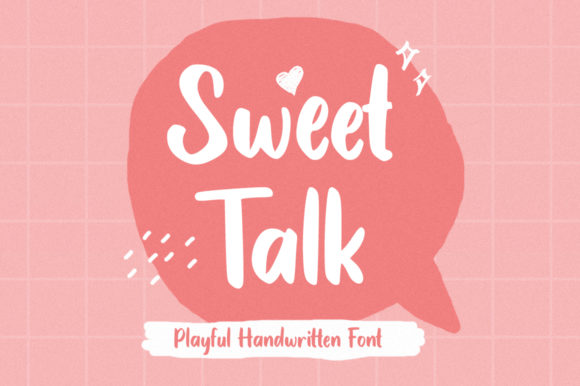
Sweet Talk: The Handwritten Font That Feels Like a Personal Note
If you've ever held a wedding invitation that made your breath catch—or scrolled past a social media post so warm and inviting you paused mid-feed—you’ve felt the quiet power of authentic handwriting. Sweet Talk isn’t just another script font. It’s a carefully crafted, magical handwritten typeface designed to carry sincerity, elegance, and quiet confidence—without a single trace of digital sterility.
What Makes Sweet Talk Feel So Real?
Sweet Talk was drawn by hand—not traced, not algorithmically smoothed, but deliberately inked with variation in stroke weight, subtle inconsistencies, and natural rhythm. That means no two “a”s look identical. Letters connect with gentle, organic flow—not rigid joins—and spacing breathes like real pen-on-paper writing. It’s not overly ornate or fussy; instead, it balances grace with approachability. Think soft curves, delicate terminals, and a slight upward tilt that suggests warmth and optimism.
This authenticity is why designers, small business owners, and DIY creators reach for Sweet Talk when they want their words to land like a personal promise—not a broadcast.
Wedding Invitations That Whisper “This Is Special”
For couples planning their big day, every detail carries emotional weight—and typography is no exception. Sweet Talk elevates names, dates, and venue details with tenderness and timelessness. Use it for the couple’s names on the front of the invite, then pair it with a clean serif for body text (like Playfair Display or Cormorant Garamond) for elegant contrast. It works beautifully on textured cotton paper, letterpress prints, or even digital RSVP cards that mimic stationery aesthetics.
Real-world note: A bride in Portland told us she chose Sweet Talk because her guests kept saying, “It feels like you wrote this just for me.” That’s the magic—it scales intimacy, even at 100+ guests.
Small Business Branding With Heart
Coffee shops, florists, boutique bakeries, and handmade jewelry makers don’t need corporate fonts—they need voices. Sweet Talk adds humanity to product labels, shop signage, and Instagram bios without sacrificing polish. One candle maker uses it for scent names (“Honey & Rain,” “Vanilla Smoke”) on minimalist kraft labels—soft enough to feel artisanal, strong enough to hold attention on a crowded shelf.
Pro tip: Avoid using Sweet Talk for long paragraphs or dense pricing tables. Its strength lies in short, evocative phrases—logos, taglines, featured offers, or handwritten-style callouts in Canva or Adobe Express.
Social Media Posts That Stop the Scroll
In a feed flooded with bold sans-serifs and AI-generated graphics, Sweet Talk stands out by being gently human. Try it for quote graphics (“You’re exactly where you need to be”), limited-time announcements (“Only 3 left!”), or heartfelt captions layered over lifestyle photos. Because it’s optimized for screen readability (unlike some ultra-thin scripts), it remains legible even at smaller sizes on mobile—especially when paired with generous letter-spacing and high-contrast backgrounds.
Observation: Accounts using Sweet Talk in story text overlays see higher engagement on sentimental or seasonal content—think Mother’s Day notes, holiday greetings, or “just because” appreciation posts.
Greeting Cards That Don’t Feel Mass-Produced
Whether you're designing printable cards for Etsy, crafting physical sets for local gift shops, or making one-of-a-kind notes for clients, Sweet Talk delivers emotional resonance. It softens formal messages (“With deepest sympathy”) and sweetens playful ones (“You’re my favorite human”). Its lowercase “g” and “y” have charming loops; its ampersand is a tiny work of art—details that make recipients pause and smile.
Who Benefits Most—and How They Use It Differently
- DIY Couples: Download the font, drop it into Word or Google Docs (via desktop apps), and personalize invites in under an hour—no design degree needed. Just avoid stretching or distorting the letters; let Sweet Talk breathe at its natural width.
- Freelance Designers: License Sweet Talk for client projects—from wedding suites to brand guidelines. Its OpenType features (like stylistic alternates and ligatures) let you fine-tune character combinations for maximum elegance.
- Educators & Therapists: Use it in handouts, affirmation cards, or classroom posters where warmth supports learning or emotional safety. One school counselor shared how students respond more openly to worksheets set in Sweet Talk versus standard fonts—it feels less clinical, more companionable.
- Content Creators: Layer it over reels or YouTube thumbnails for soft, memorable text hooks (“Let’s begin again,” “Your peace matters”). Just keep text minimal—three to five words max—to preserve clarity.
Things to Keep in Mind Before You Type
Sweet Talk thrives in context—but it’s not universally flexible. Here’s what to consider:
- Legibility at small sizes: It shines at 24pt and up. For body copy or footnotes, switch to a friendly sans-serif or readable serif.
- License clarity: Free versions often lack full character sets or commercial rights. If you’re selling products or representing a brand, invest in the licensed version—it includes multilingual support, numerals, punctuation, and extended Latin characters.
- Pairing matters: Contrast is kind. Pair Sweet Talk with structured, grounded fonts—not other scripts. Try it with Montserrat for modern balance, Lora for classic warmth, or Inter for clean digital harmony.
- Not for data-heavy layouts: Avoid using it in charts, multi-column brochures, or legal disclaimers. Its personality is best reserved for moments that invite feeling—not scanning.
A Font With Quiet Confidence
Sweet Talk doesn’t shout. It leans in. It’s the difference between a generic “Thank You” and a “Thank you—really, from the heart.” Whether you’re sealing an envelope, posting a story, or stamping a label, it reminds people that care lives in the details. And in a world moving faster every day, choosing a font like Sweet Talk is a small, meaningful act of intention—telling your audience, “You’re worth the extra thought.”
So if your goal isn’t just to communicate—but to connect—Sweet Talk might just be the voice your project has been waiting for.